
Same adoption. Different monetary paths.
The table holds Mark’s default 2050 share at 15% and uses the same supply denominator. Only the retained monetary control changes.
| Monetary path | 2050 combined pie | Share held fixed | Implied nominal BTC price |
|---|---|---|---|
| Reference monetary path | $6,152.87T | 15% | $43,977,147 |
| No continued monetary deepening | $3,608.82T | 15% | $25,793,766 |
| Recent monetary-growth trend | $3,033.49T | 15% | $21,681,613 |
No continued monetary deepening removes the persistent rise in the money/GDP ratio. Recent monetary growth uses the shorter retained ratio trend instead. These are two specific tests of the monetary assumption, not arbitrary lower and upper forecasts.
[MODEL]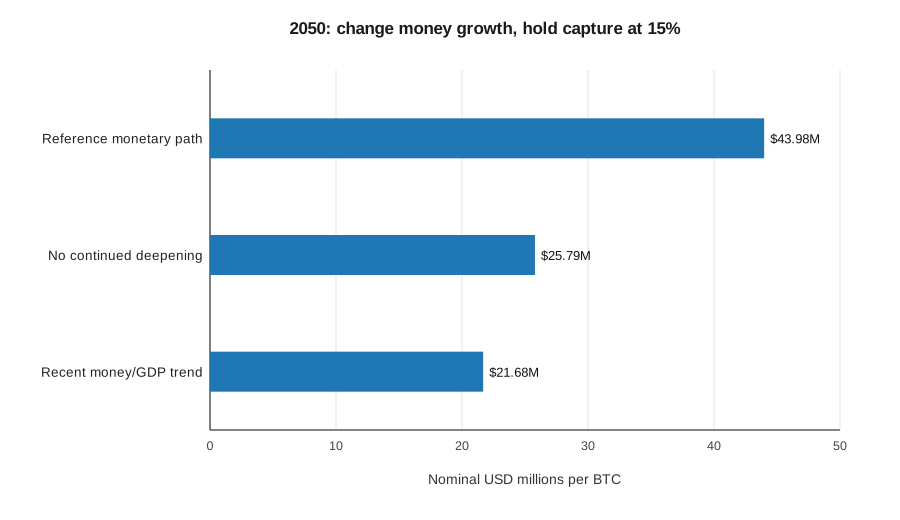
Same market. Different adoption.
Now hold the reference pie fixed and change only the Bitcoin-share preset. This is the separate adoption question.
| Preset | 2050 share | Implied nominal price |
|---|---|---|
| Conservative thesis | 10.00% | $29,318,098 |
| Mark’s thesis | 15.00% | $43,977,147 |
| High adoption | 20.00% | $58,636,195 |
At a fixed pie and supply, doubling the share doubles the implied price. That is a mathematical identity, not evidence that adoption itself can be doubled. The app makes this dependence visible so the reader can see where conviction enters.
[MODEL]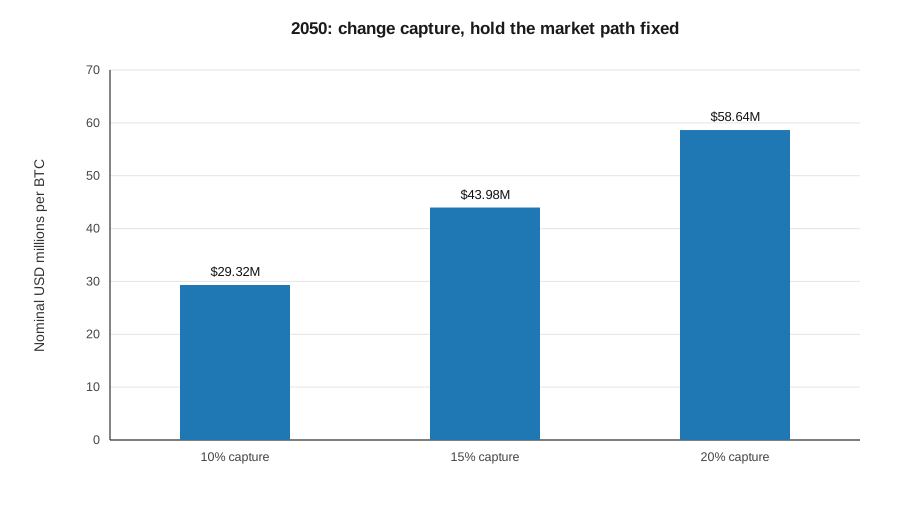
Nominal dollars are not unchanged purchasing power
The headline outputs are future nominal U.S. dollars. They do not have the same purchasing power as a dollar in 2025.
For illustration, the retained 2.3% annual consumer-inflation assumption makes a 2050 dollar worth approximately 0.57 dollars in 2025 consumer purchasing power. On that assumption, the default reference 2050 price of $43,977,147 is approximately $24,907,848 in 2025 dollars.
This is an illustration, not a new inflation forecast. SOV-market growth is not the same thing as consumer-price inflation. No inflation uplift is added to the nominal forecast a second time.
[MODEL]These tables are not a safe range
The lowest displayed preset is not a floor for Bitcoin. The controls do not exhaust possible technical, competitive, monetary or demand outcomes. A much smaller share, slower market growth, or both can produce a substantially lower result; zero future share produces zero modeled allocation.
The most informative test is specific: identify the disputed assumption, change it, and hold the rest fixed. The uncertainty does not disappear because the output is precise to the dollar. That precision is useful for checking arithmetic, not for claiming forecasting accuracy.
In the calculator, use the macro selector for the market question and the sliders for the adoption question. Export the selected scenario with its version and assumptions so another reader can reproduce exactly what you changed.
[MODEL][BTC-FAQ]